
 首頁
會員文章
【堅離地報聯盟:The Diplomat 🇯🇵】 The History of Japan’s Nobel Peace Prize-Winning Nuclear Survivors’ Group


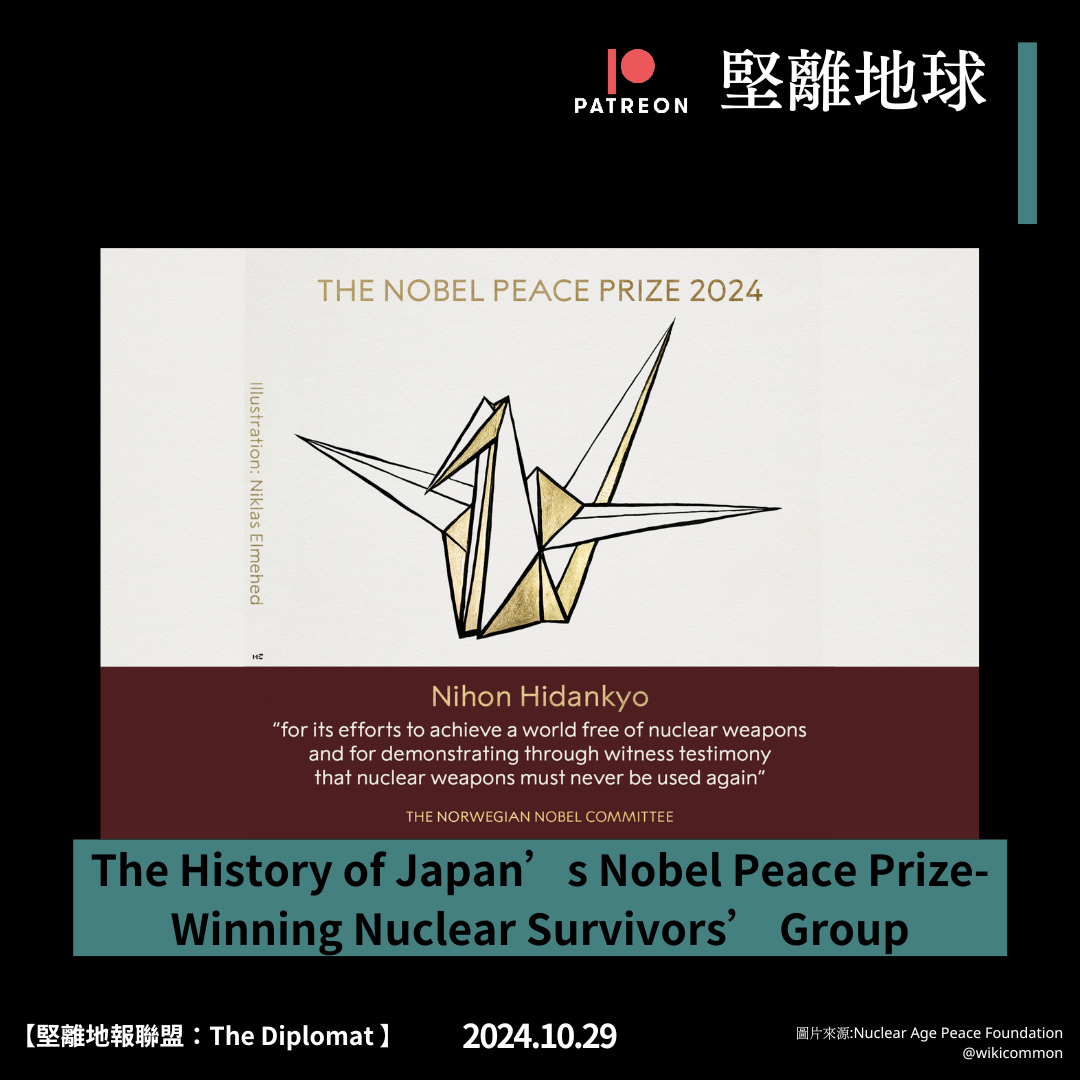
【按:本月《堅離地報聯盟》會員區挑選的《The Diplomat》付費文章,概述了2024年諾貝爾和平獎得主「日本原爆受害者團體協議會」(Nihon Hidankyo)的歷史。該組織由廣島和長崎原子彈爆炸倖存者於1956年成立,除了推動《禁止核武器條約》,還致力於改變日本政府對美國核武的依賴,並非單純的反戰組織,同時也有影響現實外交的另一面。】
The 2024 Nobel Peace Prize has been awarded to Nihon Hidankyo, a Japanese grassroots organization created by survivors of the two U.S. atomic bombs that were dropped on the cities of Hiroshima and Nagasaki in August 1945.
The Norwegian Nobel committee recognized the organization “for its efforts to achieve a world free of nuclear weapons and for demonstrating through witness testimony that nuclear weapons must never be used again.”
Discussion of the bombings, which killed more than 100,000 Japanese people, was largely a taboo in the immediate post-war period. This was, in part, thanks to U.S. press censorship in occupied Japan.
But, in 1954, an American nuclear weapons test at Bikini Atoll in the Pacific Ocean produced such extensive radioactive fallout that it affected a Japanese fishing boat, the Lucky Dragon, causing one death from radiation poisoning.
The Lucky Dragon incident prompted many of the atomic bomb survivors, who are known as the hibakusha, to speak out about their experiences. And it was within this context that Nihon Hidankyo was created in 1956.
Since then, the hibakusha have played an immeasurable role in activism against nuclear weapons worldwide. Their testimony, the Nobel committee said, has “helped to generate and consolidate widespread opposition to nuclear weapons around the world.”
In 1975, for example, a group of hibakusha that included Setsuko Thurlow, a member of Nihon Hidankyo and a globally renowned campaigner against nuclear weapons, organized an exhibition on the atomic bombings at the Toronto public library. This helped trigger the development of a significant anti-nuclear movement in Canada. By the early 1980s, tens of thousands of Canadians regularly demonstrated against their government’s support for U.S. nuclear weapons.
Then, in 1984, another survivor of the Hiroshima bombing called Takashi Morita co-founded a hibakusha organization based in São Paulo to share their stories and raise awareness in Brazil of the devastating consequences of nuclear weapons.
Growing awareness of the experiences of the hibakusha throughout the 1980s inspired Europeans to protest against the deployment of new nuclear missiles in their countries. The phrase “no Euroshima!” became a popular slogan for the European peace movement.
Nihon Hidankyo’s efforts have focused not only on sharing the experiences of hibakusha, but also using them to gain support for the abolition of nuclear weapons worldwide.
The organization has been a key supporter of the United Nations Treaty on the Prohibition of Nuclear Weapons. This treaty, which entered in force in 2017 and has been signed by 94 countries, prohibits states from participating in any nuclear weapon activities.
The International Campaign for the Abolition of Nuclear Weapons – in which Setsuko Thurlow is a leading figure – was awarded the Nobel Peace Prize in 2017 for its efforts to achieve this legally binding prohibition of such weapons.
Within Japan, Nihon Hidankyo has worked to challenge the government’s position on nuclear weapons. The Japanese government is supportive of U.S. nuclear weapons, despite the horrors witnessed in Hiroshima and Nagasaki, and depends on them as a deterrent against its several nuclear-armed neighbors.
Successive Japanese governments have insisted on the importance of nuclear weapons for the country’s national security. But it remains a controversial stance for many in Japan. Every Japanese school child typically visits Hiroshima or Nagasaki to learn about the nightmarish consequences of nuclear weapons.
The decision to award the Nobel Peace Prize to Nihon Hidankyo is particularly timely. In 2023, the world’s nine nuclear powers spent over $91 billion on nuclear weapons. And since Russia’s invasion of Ukraine in 2022, Russian President Vladimir Putin has repeatedly threatened to use his nuclear arsenal.
These concerning developments were acknowledged by the Nobel committee. When awarding Nihon Hidankyo with the prize, the committee said it was “alarming that today this taboo against the use of nuclear weapons is under pressure.”
The world’s nuclear powers – especially China and the United States – are expanding and modernizing their arsenals. North Korea is continuing to develop its nuclear weapons program. And tensions are fast escalating between nuclear-armed Israel and near-nuclear Iran.
The threats posed by nuclear weapons are more apparent now than they have been at any time since the Cold War. With barely 100,000 hibakusha alive today, it is imperative that we listen to their voices and their warnings.
Author: Eirini Karamouzi and Luc-André Brunet
▶️ 美國前國務卿、諾貝爾和平獎得主 基辛格逝世:重溫他滿手鮮血的一生
https://www.youtube.com/watch?v=vDuyYE_dVho


