


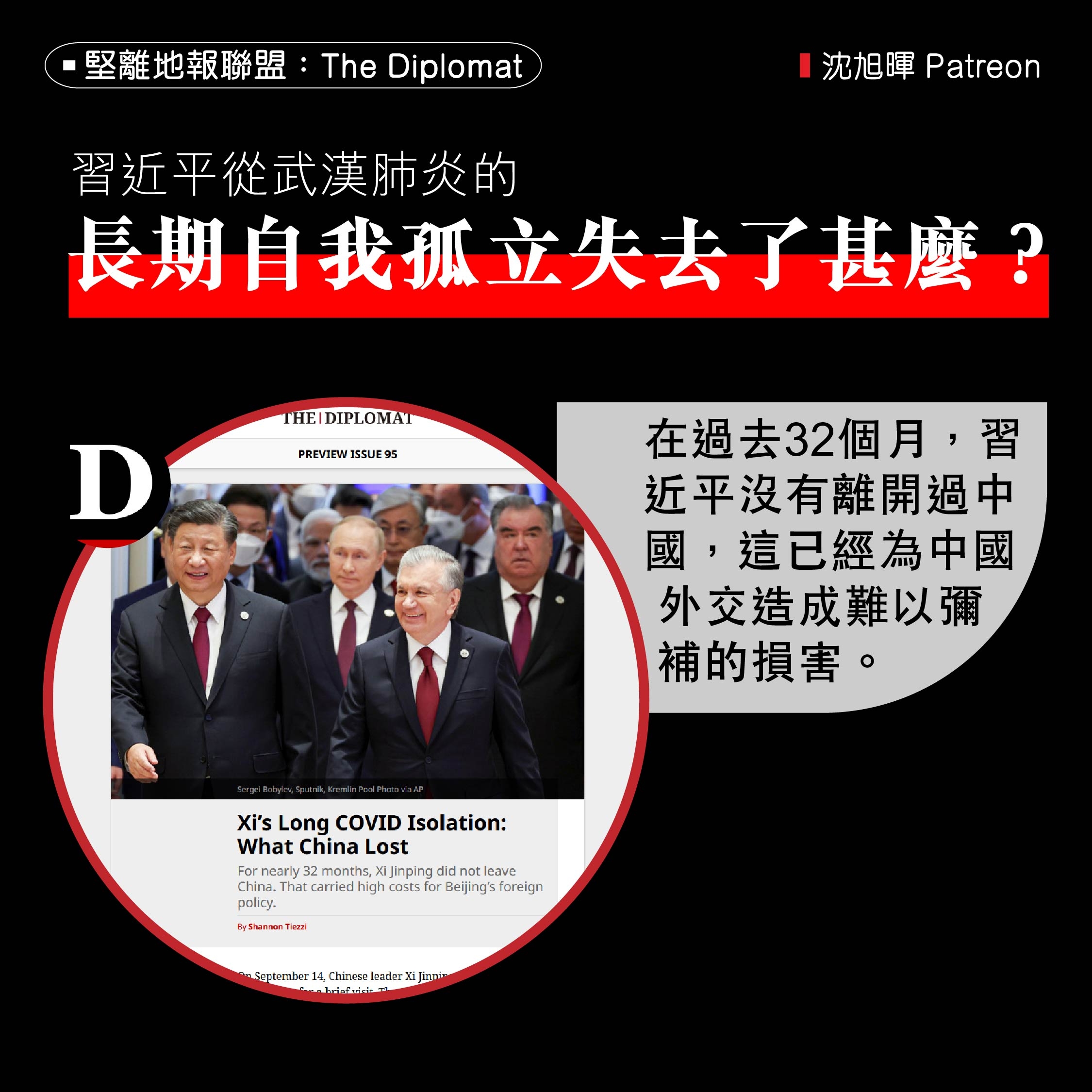
【按:本月我們為「堅離地報聯盟」會員再選擇了The Diplomat付費雜誌這篇文章,講述中共二十大之際,習近平在「清零」的兩年在國際社會失去了甚麼,對中國外交的代價,其實遠比想象中嚴重。】
On September 14, Chinese leader Xi Jinping arrived in Kazakhstan for a brief visit. The overnight trip would not have been especially remarkable – Xi has traveled to Kazakhstan four times since assuming China’s top leadership post in November 2012 – were it not for one thing: It was Xi’s first time setting foot outside China in 970 days.
On January 18, 2020, Xi wrapped up a two-day trip to Myanmar. That trip also seemed fairly typical diplomatic fare. At the time, however, what would become known as the COVID-19 pandemic was spreading rapidly through Wuhan, China. Five days after Xi returned home, on January 23, 2020, the lockdown of Wuhan began. China largely closed itself off from the outside world, severely curtailing flights and visa issuances.
Xi himself would not leave the country for two years and nearly eight months.
Prior to the COVID-19 outbreak, Xi averaged trips to 13 foreign countries each year, attending at least four international summits (always the APEC, BRICS, G-20, and Shanghai Cooperation Organization summits, and often others, like the 2015 U.N. Climate Change Conference or the U.S.-hosted Nuclear Security Summits in 2014 and 2016). In 2020, Xi visited just one country and attended no international summits before the pandemic took hold; in 2021 he did not leave China at all.
Why? COVID-19, of course. As Mu Chunshan, a Beijing-based analyst, told me, Xi was likely discouraged from traveling abroad due to the health risks (including not only the individual risk to himself but also the possibility of spreading COVID-19 to other Chinese leaders). Then there were perception issues to deal with.
“[T]he Chinese government had enough reason to not encourage citizens to frequently go out and return to the country, which will put great pressure on China''s zero-COVID policy,” Mu said via email.
“...If Xi and his officials go abroad frequently, Chinese people will think they are enjoying special treatment during the pandemic and will question the zero-COVID policy more.”
By September 2022, however, the time was ripe for a change. “Although China is still insisting on the zero-COVID policy now, I found starting from July, the Chinese government has begun to gradually open up,” Mu said. “...Xi and the Chinese government are indeed ready to resume foreign visits and normal international exchanges,” which Mu called “an indicator of [Xi’s] confidence in the pandemic in China and the world.”
But what damage was done to China’s diplomacy in the meantime?
Since 2020, numerous studies and opinion polls have found that global perceptions of China dropped sharply. Of course this may be just coincidence, not directly related to Xi’s long stay at home. There are many factors that played into the rise in negative sentiment: the central and local governments’ mishandlings of the initial emergence of the pandemic, a more belligerent diplomatic tone that rubbed many foreigners the wrong way, and increasing perceptions of China as a threat. But if Xi’s absence from the global stage didn’t contribute to the decline in China’s image, it certainly didn’t help.
For well over two-and-a-half years, Xi had no chance to do the grip-and-grin rituals of top-level diplomacy, tour (and lavishly praise) other countries’ cultural landmarks, or visit their schools – no chance, in other words, to take part in the normal practice of foreign visits. He lost valuable facetime with fellow leaders and the opportunity to make a lasting impression on the citizens of countries he visited.
In fact, Xi’s long period of COVID-induced isolation within China caused him to miss a number of much-anticipated foreign visits. The first casualty was a long-planned summit to Japan, set to take place sometime in April 2020. Likewise, Xi was supposed to visit neighboring South Korea later that same year. Both trips were scrapped and have yet to take place two years later.
The April summit would have been Xi’s first purely bilateral trip to Japan since taking office (in 2019, Xi went to Osaka to attend the G-20 summit). As for South Korea, Xi has not visited the country since 2014. Perhaps more importantly than the timelines alone, however, Xi’s visits to both Japan and South Korea were supposed to continue a slow process of diplomatic thaws in previously strained relationships. When that didn’t happen, neither did the hoped-for thaws – China-Japan and China-South Korea relations have remained essentially stuck in place, if not actively worsened, since 2020.
China also missed a key chance to improve relations with Europe, which are now badly frayed due to Beijing’s tacit support for Russia’s invasion of Ukraine. Outgoing German Chancellor Angela Merkel had long planned to cap off her tenure by hosting a massive in-person summit between Xi and European leaders during Germany’s European Union presidency, from July to December 2020. That was not to be, another casualty of the pandemic. Instead, Xi held a videoconference summit with more limited attendance: Merkel, France’s President Emmanuel Macron, as well as European Council President Charles Michel and European Commission President Ursula von der Leyen.
China and the EU announced a much-anticipated bilateral investment treaty at the virtual summit, but the exchange was not enough to assuage rising tensions between the two, driven by European concerns over China’s economic practices and human rights abuses. By early 2021, the EU had placed sanctions on China over its abuses in Xinjiang; China retaliated, and the European Parliament placed the hard-won treaty on ice, where it remains today.
It seems very unlikely that Xi would be welcomed to a pan-EU summit today, given the extreme tensions that grew out of China’s stance on the Russian invasion of Ukraine. An in-person summit in 2020 wouldn’t have magically solved all the issues, but it would have given China more to work with than it currently has in relations with the EU.
Xi did have another chance to visit Europe. In October 2021, Rome hosted the G-20, which had returned to its in-person format. The Chinese leader had attended the G-20 summit every year since taking office; 2021 was the first year he missed an in-person gathering, instead settling for attendance through video link. Xi was one of just five top leaders from the G-20 countries to send a minister to Rome in his place.
As a corollary, Xi missed out on a host of potential sideline meetings, including what could have been his first in-person conversation with U.S. President Joe Biden as well as much-needed chances to talk face-to-face with European leaders.
Xi also skipped the triennial meeting of the Forum on China-Africa Cooperation (FOCAC) in Senegal in November 2021, which would have been his first trip to Africa since 2018. Given the importance China places on its relationships with African countries, missing out on this summit, which brings together China’s top leader and the leaders of all the African countries which with China has diplomatic relations, was a big blow.
Worse, it’s rumored that Xi’s refusal to attend was the reason the summit – originally expected to be a leaders’ summit – was downgraded to a ministerial meeting. That rankled host Senegal, which had been expecting the full pomp and circumstance of a top-level gathering. The downgrade may also explain why FOCAC 2021 got far less media attention than FOCAC 2018 – sparking many an op-ed arguing that China’s influence and interest in Africa were waning.
For China, Xi’s absence from FOCAC 2021 in Senegal (which, under ordinary circumstances would certainly have been just one stop on a multi-country tour of the African continent) was a missed opportunity to shape the narrative on Africa-China relations. Beijing must regret that now, as the economic turmoil of 2022 has refocused attention on the emerging debt crisis in the developing world, including African countries like Zambia where China is a top lender.
It’s impossible to know what would have been different if Xi had returned to international travel a bit earlier – perhaps in mid-2021, when much of the rest of the world reopened. But the Asia-Pacific region puts a particular premium on simply being present for annual summitry, and Xi did not do that for nearly 32 months.
A famous quip from Woody Allen holds that “90 percent of life is showing up.” If the same is true for diplomacy, then China’s foreign policy has been operating at just 10 percent capacity since January 2020. Now he’s back in the game, but there’s plenty of ground to make up.


 首頁


