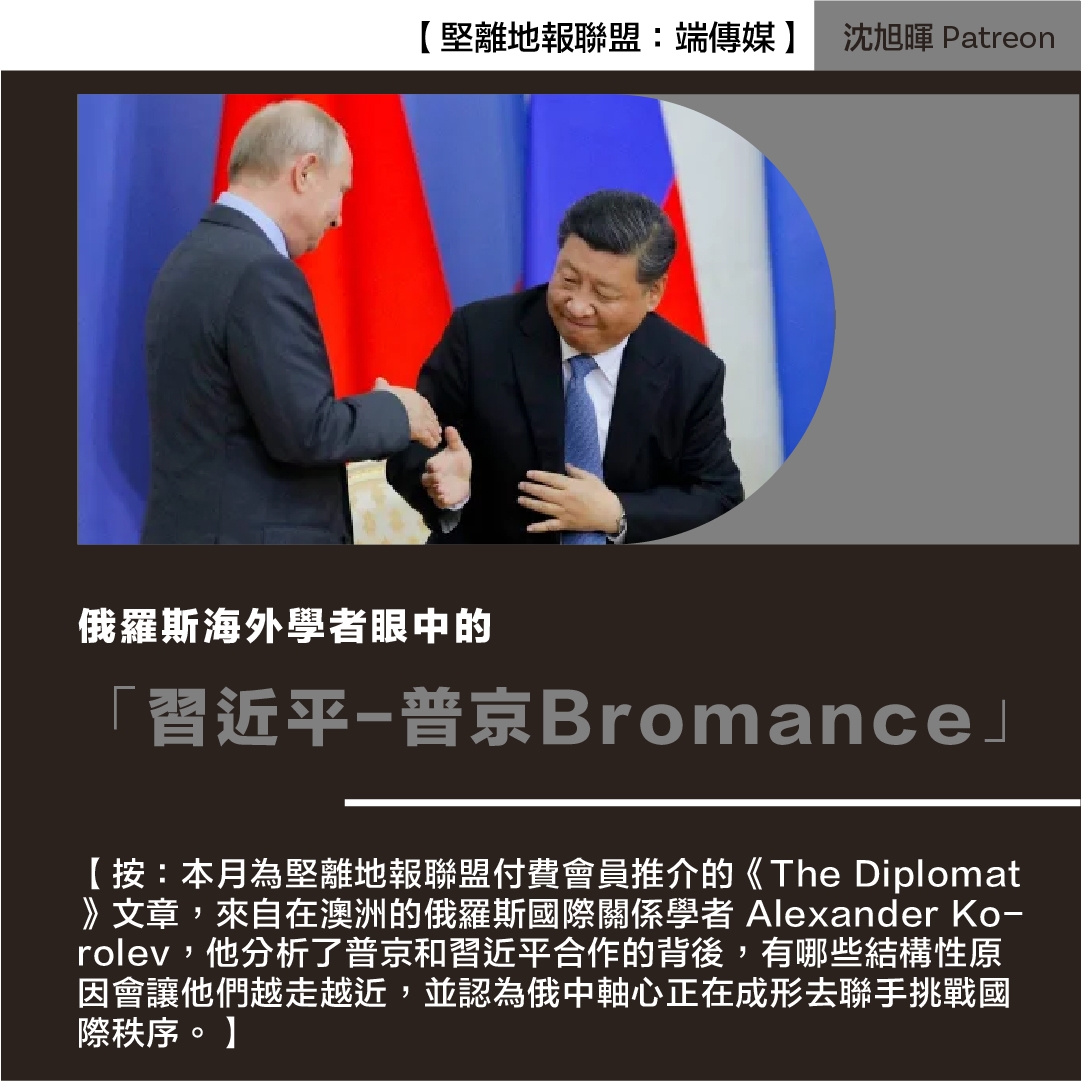
【按:本月為堅離地報聯盟付費會員推介的《The Diplomat》文章,來自在澳洲的俄羅斯國際關係學者 Alexander Korolev,他分析了普京和習近平合作的背後,有哪些結構性原因會讓他們越走越近,並認為俄中軸心正在成形去聯手挑戰國際秩序。】 On February 4, 2022, the opening day of the Winter Olympics in Beijing and only 20 days before Russia invaded Ukraine, China and Russia declared a “no limits” partnership that “surpasses an alliance.” This new upgrade of the bilateral relationship has been commonly accredited to the role of Presidents Xi Jinping and Vladimir Putin or, more precisely, their special friendship. Indeed, the two leaders often describe each other as “best friends” and are believed to have a close personal relationship. Therefore, the so-called no limits partnership is actually the one between Putin and Xi. Emphasizing the role of authoritarian leaders in shaping their countries’ foreign policy is analytically justifiable. In highly centralized authoritarian political systems, such as China and Russia, channels for open policy deliberations are limited, and the impact of experts and the public on foreign policy is less significant. Moreover, in the case of China-Russia relations, significant advancements in terms of strategic alignment happened after Xi assumed control of the Chinese Communist Party in 2012. However, a more careful analysis reveals that while the Putin-Xi friendship is important, it mostly oils the wheels of a relationship driven by longer-term structural trends. Those trends are unlikely to be reversed any time soon. China-Russia strategic alignment is likely to stay, and Russia’s war in Ukraine is unlikely to cause it to unravel. The Putin-Xi Bromance and China-Russia Cooperation From the moment Xi became CCP general secretary in 2012, China-Russia relations displayed a new upward trend. Being of roughly the same age, Putin and Xi have long been seen as friends with a level of trust higher than what had been the norm between the two countries. According to some observers, “Putin has more trust in Xi than in any Chinese leader before him and any current Western leader” and the “sincerity that Putin feels in Xi has helped the Kremlin to adjust many policies towards China.” Xi selected Russia as the destination of his first foreign trip after assuming the presidency and became the first foreign leader to visit the Russian military command center in Moscow. He emphasized at the time that “strong China-Russia relations not only answer to our interests but also serve as an important, reliable guarantee of an international strategic balance and peace.” Putin, in turn, stated that China and Russia were “natural partners and natural allies,” using the word “ally” that Moscow had previously eschewed with respect to China. Putin and Xi have met with each other more than 40 times since 2012, and their words of greeting have evolved from “dear president” to “dear friend” and later to “my old friend.” During the 2014 phase of the Ukraine crisis, when Russia annexed Crimea and established separatist governments in Ukraine’s Donbas region, Putin-Xi relations did not waver. Not only did the Ukraine crisis of 2014 not shake the base of the China-Russia strategic partnership but, in fact, it pushed it to the next level. When Russia faced isolation and sanctions, Xi consistently demonstrated his personal support for Putin. The two leaders met six times during 2014 – in Sochi, Shanghai, at the Shanghai Cooperation Organization (SCO) summit in Dushanbe, the BRICS in Fortaleza, the G-20 in Brisbane, and APEC in Beijing. At each meeting, Xi did not eschew displaying a good relationship with Putin. What’s more, Chinese soldiers marched in Moscow during the Victory Parade on May 9, 2015, when many Western leaders turned down Russia’s invitation to join in because of Ukraine. By pointedly sitting beside Putin in Red Square during the parade, Xi made clear to the world that China emphatically does not bow to Western pressure on Russia. The Putin-Xi bromance appears to be more than symbolic. During Xi’s tenure, the portfolio of China-Russia cooperation has progressed both quantitatively and qualitatively. In 2015, the Chinese navy made its first historic visit to the Russian port of Novorossiysk, after which the geographic scope of regular joint military exercises increased. In May 2015, the Russian and Chinese navies conducted their first joint naval exercises in the heart of NATO – the Mediterranean. A year later, the China-Russia “Joint Sea-2016” naval exercise became the first major drill of its kind involving China and a second country in the South China Sea after a Hague-based international tribunal overruled China’s claims to the waters. The increasing operational complexity of these joint exercises has laid the foundation for potential simultaneous joint military actions in multiple theaters of operation. This is believed to enable China and Russia to draw the attention and capabilities of the United States and its allies to a specific region, reducing their ability to react to, for example, Chinese actions in the Pacific or Russia’s in western Eurasia. Indeed, as some recent congressional reports specified, the U.S. might struggle to win a war against China or Russia if forced to fight on two or more fronts simultaneously. Moscow and Beijing also started to emphasize that their positions on most international issues are “similar or identical” or lack “any problems that cannot be solved.” In May 2016, China and Russia launched a new annual joint military exercise – “Airspace Security” – which became the first China-Russia computer-simulated missile defense exercise. Three years later, in October 2019, Putin announced that Russia was actively helping China to create a missile attack early warning radar system, which would fundamentally enhance China’s defense capability. Russia sharing such early warning capabilities with China was considered unprecedented for China-Russia relations from both the historical and military-technical standpoints, and thus represented a significant leap in terms of bilateral trust. By most indicators, Putin and Xi managed to mitigate, if not eliminate, the existing psychological and political barriers to closer cooperation. Xi’s government also appeared more sensitive and responsive to the sore points of bilateral economic cooperation, namely Russia’s fears of becoming little more than an energy appendage to China. While continuing to advance energy cooperation with Russia, Xi demonstrated a willingness to double down on cooperation in engineering, manufacturing, and finance – areas prioritized by Putin. In this context, agreements on the joint design and production of a wide-body civil aircraft and a large military helicopter were signed. The central banks of Russia and China also agreed to carry out a foreign-exchange swap worth 150 billion renminbi. Remarkably, of the multiple cooperation agreements signed during Xi’s symbolic visit to Moscow in 2015, only 24 percent were related to natural resources. The areas of finance, banking, and investment stood out, accounting for 38 percent of all agreements, followed by R&D and high tech (21 percent) and transport and infrastructure (10 percent); the remaining 7 percent were related to media and information security. This composition demonstrates an attempt to transform the energy-dominated pattern of economic cooperation. To enhance bilateral trust, Xi and Putin even started to reshape the collective consciousness of the Russians and Chinese to revise negative historical memories that kept haunting bilateral relations. As a method, they chose fostering a historical common ground on an issue that is more significant than those causing disagreements. Thus, China and Russia began to construct a new joint historical narrative about their participation in World War II – in the form of the Great Patriotic War (June 22, 1941 to May 9, 1945) for Russia and the War of Resistance Against Japanese Aggression (July 7, 1937 to September 9, 1945) for China. To achieve that goal, Putin and Xi signed a 2014 declaration that stated that the two countries “will organize joint events to commemorate the 70th anniversary of the victory over German fascism and Japanese militarism … And will continue to vigorously oppose any attempts to falsify the history.” The emphasis on their joint role in WWII and the resistance against any revisionism that diminishes Russia’s and China’s contributions to a victory of global importance became a part of subsequent bilateral formal statements. Both Putin and Xi sent special greetings to multiple regular conferences, workshops, exhibitions, and media events commemorating the joint China-Russia historical mission in WWII and emphasizing its importance for the development of contemporary China-Russia relations. In one such greeting, Putin emphasized that “the peoples of our countries… fighting shoulder to shoulder… contributed decisively to victory over the enemy” and that “Russians will never forget the courage and heroism of our Chinese brothers-in-arms who gave their lives for our common victory.” Xi, in turn, declared that “joint celebrations of victory in memory of the heroic combatants, the finest sons of Russia and China who fell for justice, light, and freedom, is of the absolute highest importance.” He also talked about the need to “strengthen the traditional friendship between the peoples of Russia and China, bound by the blood spilled for victory.” The effort to comprehensively boost China-Russia relations is undeniably associated with Putin and Xi. That said, writing off the consolidating China-Russia alignment as personally dependent on the two leaders, however powerful, is a form of analytical reductionism. A closer look at the case of China-Russia relations reveals that the main causes of increased bilateral alignment operate at the international-systemic level. Xi’s tenure and Putin’s return for his third presidency coincided with shifts in the global power balance. This does not make Putin and Xi irrelevant but places them in the role of facilitators and materializers of the international structure’s dispositional pressures. Structural Shifts in Great Power Politics There are strong international-systemic factors that drive China-Russia alignment and compel China not to turn its back on Moscow. Graham Allison’s well-known research on power transitions (shifts of the global balance of power in which a rising power catches up with or surpasses the dominant great power) suggests that out of 16 studied power transitions, only four were peaceful. In the contemporary international system, a power transition is happening between China and the United States. According to the World Bank, in 1991, the United States’ total GNP of $6.2 trillion was more than 16 times that of China ($383 billion). However, by 2013, just as Xi came to power in China, the country’s GNP reached more than half of that of the U.S. ($9.6 trillion vs. $16.8 trillion). By 2019, it had become almost 70 percent ($14.3 trillion vs. $21.4 trillion). Thus, the current great power structure resembles the one that existed during the Cold War, when the Soviet Union’s GNP reached its peak of roughly 60 percent of the U.S. total in 1975. These structural shifts determine the horizons of probable actions for great powers, regardless of who oversees foreign policy. They also intensify great power rivalry. Relevant research demonstrates that an established superpower (the United States, in this case) represents the greatest threat to states that are on the cusp of becoming superpowers (i.e. China). China started to be perceived by the U.S. as more aggressive and nationalistic, which required a balancing response. In turn, U.S. foreign policy projects such as the Obama era “pivot to Asia” and the current “free and open Indo-Pacific” were both viewed in Beijing as security threats and attempts to contain China. In January 2012 (10 months before Xi assumed office), Washington adopted new strategic guidelines that identified China as a threat in the Asia-Pacific and introduced the new Joint Operational Access Concept (JOAC) that required increasing the deployment of U.S. naval capabilities to the Asia-Pacific. In December 2017, the U.S. National Security Strategy explicitly identified China as the primary competitor that drives Washington’s defense decisions and military resource allocation. The United States’ Third Offset Strategy – a defense innovation initiative to counteract strategic technological advantages by U.S. adversaries – is another of Washington’s measures to deal with the China challenge. It explicitly targeted China and included steps to engage Beijing in direct military-technical competition. Likewise, the AUKUS (Australia-U.K.-U.S.) alliance is aimed at tackling a growing threat from an “arc of autocracy” led by China. AUKUS plans to push back against China’s assertiveness by enabling regular visits of U.S. and U.K. nuclear-powered submarines to Australia’s east coast, and eventually equipping Australia with its own nuclear submarines. Meanwhile, Chinese strategists increasingly view the United States the same way the U.S. views China – as a major national security threat and the primary focus of defense policy. Chinese military experts recommended that Beijing build strategic balancing capabilities in nuclear, space, and air deterrence, “even if this leads to an intense arms race.” Some high-ranking Chinese officials said that the U.S. is China’s greatest national security threat – a perception that is widely shared in China’s defense and security establishment. The COVID-19 global pandemic was also reported to have further undermined already shaky China-U.S. relations. In this context, Xi has every reason to preserve its strategic alignment with Russia, which, given Russia’s anti-U.S. foreign policy orientation, military and geopolitical characteristics, permanent seat in the U.N. Security Council, and authoritarian political regime, presents the most effective way to counterbalance against U.S. power. The United States explicitly identifying both China and Russia as major strategic threats further contributes to the consolidation of China-Russia alignment. China is given a primary place in the U.S. defense strategy, whereas Russia is dubbed as a “revitalized malign actor” that must be contained through sanctions. Confrontation with both China and Russia results in a convergence of the two countries’ views of the U.S. as their greatest security threat. It also suggests a lack of questioning within Washington’s strategic establishment if adopting a hostile attitude toward both China and Russia makes strategic sense. In the context of the evolving global power balance, the simultaneous deterioration of China-U.S. and Russia-U.S. relations generates an external compulsion that removes any remaining political barriers to closer China-Russia alignment. The Ambivalen...


 首頁


